

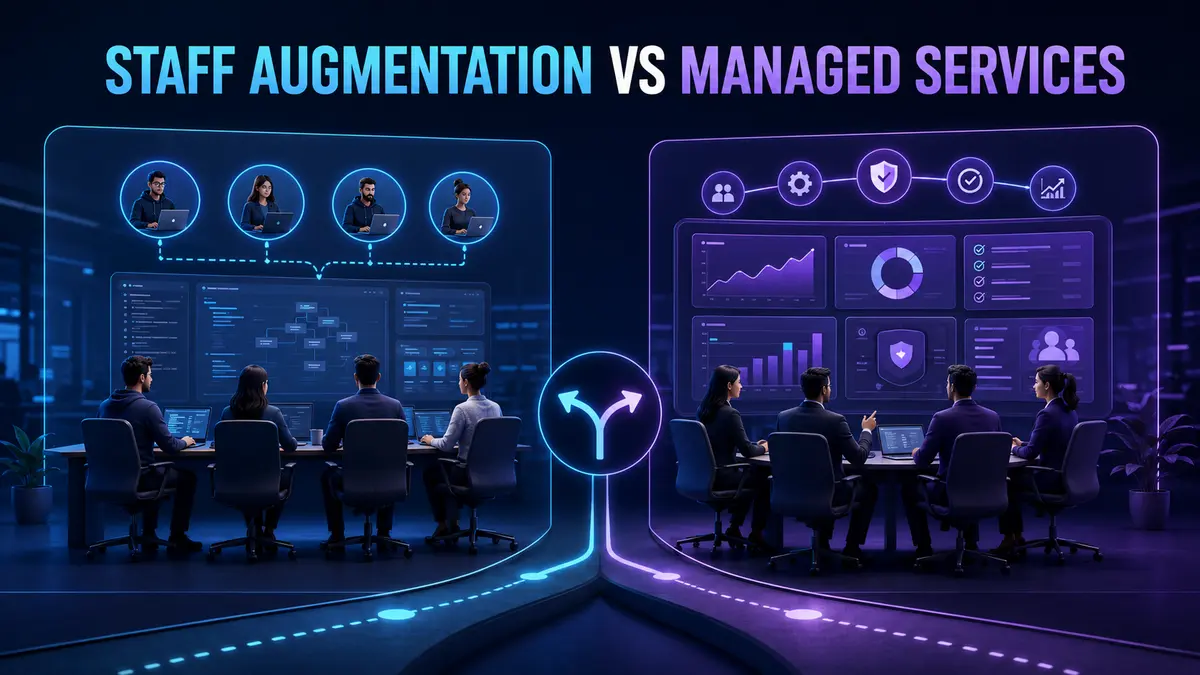
Staff augmentation adds external specialists to a team that your business continues to manage. Managed services assign a defined service or outcome to a provider that manages the people, process and delivery. The right model depends mainly on where you want responsibility to sit.
Choose staff augmentation when you have strong internal leadership and need more capacity or a specific skill. Choose managed services when you want a provider to own an ongoing function with measurable service levels. Neither model is automatically cheaper or better. The decision should follow the work, available management capacity and level of accountability required.
In staff augmentation, external professionals work within your delivery structure. Your managers usually set priorities, assign tasks, review work and resolve dependencies. The provider supplies talent, but your organization remains responsible for the result.
In a managed service, the provider owns a defined operational scope. It decides how to organize its team and processes within agreed boundaries. Your business governs the contract, service levels and outcomes rather than managing each person.
| Decision area | Staff augmentation | Managed services |
|---|---|---|
| Daily direction | Led by your managers | Led by the provider |
| Primary purchase | Skills and capacity | Service and outcomes |
| Performance measure | Individual contribution and delivery | Service levels and business results |
| Process ownership | Your organization | The provider within scope |
| Scaling | Add or remove named roles | Adjust service capacity and scope |
| Best fit | Projects with internal leadership | Repeatable ongoing operations |
Staff augmentation works well when a capable internal team needs temporary capacity, scarce expertise or faster hiring. It can support a product launch, platform migration, testing period or backlog reduction without creating a permanent position for every short-term need.
The model gives your organization direct control over priorities and technical decisions. It is especially useful when the work changes frequently and cannot be described as a stable service in advance.
However, added people also create management work. They need onboarding, system access, product context, clear tasks and timely review. If internal leaders are already overloaded, adding specialists may increase coordination pressure rather than remove it.
Managed services are a strong fit for repeatable functions such as infrastructure monitoring, service desk operations, application maintenance, security monitoring or cloud operations. The provider can standardize tools and processes across the service.
This model gives the buyer one accountable service owner. Instead of filling schedules and assigning individual tasks, your team reviews performance, risk and improvement. It can reduce day-to-day management effort when the scope is clear.
A managed service becomes difficult when responsibilities are vague. If the provider cannot control important dependencies, it may be unable to meet the promised outcome. Contracts should name assumptions, exclusions, customer responsibilities and escalation paths.
Staff augmentation is often priced by role and time. The buyer pays for available capacity, while also carrying the internal cost of planning and supervision. Utilization matters because an external specialist who waits for decisions is still consuming budget.
Managed services may use fixed, usage-based or tiered pricing. Fees normally reflect scope, service hours, risk, tools and expected workload. A low fixed price may rely on narrow exclusions or aggressive volume assumptions, so buyers should compare what is included.
Total cost should include transition, access, management, tools, rework and exit. Headline rates alone do not show which model creates better value.
Staff augmentation offers direct control but retains accountability with your company. Managed services transfer operational responsibility within the contracted scope, but your business still owns strategy, risk acceptance and supplier governance.
Be precise about decision rights. Identify who approves architecture, releases, access, emergency changes and additional spending. This prevents delays when an urgent issue crosses organizational boundaries.
Both models involve external access to systems and information. Use individual accounts, least privilege, multifactor authentication and prompt offboarding. Agreements should cover confidentiality, ownership of work, use of subcontractors and the return or deletion of data.
Managed service providers may use shared tooling across customers. Ask how environments are separated and how administrative activity is logged. Staff augmentation providers should explain employee screening, device controls and replacement procedures.
A simple test is to ask what you want to buy. If the answer is a developer, analyst or engineer working under your direction, staff augmentation is likely closer. If the answer is reliable support, monitored infrastructure or maintained applications, managed services may fit better.
Many businesses combine both approaches. A managed team can operate a defined service while augmented specialists work on temporary modernization or migration projects. The key is to define handoffs between project delivery and ongoing operations.
For example, an augmented development team may build a new feature, then transfer runbooks and ownership to an application maintenance provider. Acceptance criteria should include documentation, monitoring and support readiness.
Our guide to choosing an enterprise software partner provides additional questions for evaluating capability and fit. If your need is project-based, the guide to custom software solutions explains the main cost and delivery stages.
It is a form of external resourcing, but the buyer retains direct management of the work. That makes it different from outsourcing a complete managed function.
Yes. The commercial model is defined by responsibility and outcomes, not only by whether staff are dedicated or shared.
Staff augmentation can start quickly when roles and managers are ready. A managed service often needs more discovery and transition because the provider assumes broader responsibility.
TechFusion Gear helps businesses structure software projects, specialist teams and ongoing technology services around clear ownership. Contact our team to compare delivery models for your product, support or modernization goals.