

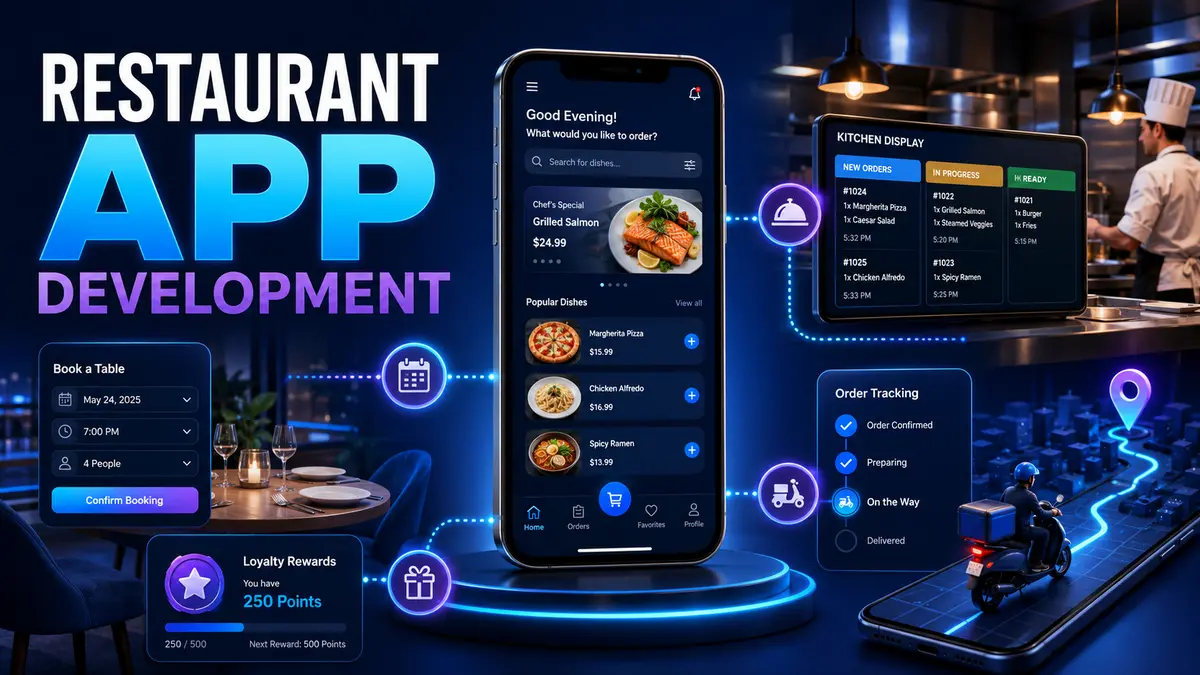
Restaurant app development creates a direct digital channel for ordering, table booking, loyalty, payments and customer communication. The application should also connect cleanly with kitchen, menu, inventory and delivery operations.
The strongest products solve a defined business problem. A restaurant may want fewer phone orders, faster repeat purchases, lower marketplace dependence or better guest retention. Features should follow that priority.
A single location, multi-location brand, cloud kitchen and marketplace need different architecture. Define who owns menus, pricing, preparation, delivery and customer support.
For several locations, decide whether products, prices and availability are shared or controlled locally. This affects data, permissions and reporting.
Keep ordering steps short and show price changes clearly. Users should know availability, preparation estimates and delivery terms before payment.
Menus change by time, location and stock. Administrators need controlled tools for products, images, prices, variants, dietary information and availability.
Changes should reach customer applications reliably. Audit records help identify who changed pricing or availability when a problem occurs.
Booking needs capacity, time slots, party size, confirmation and cancellation rules. Staff should see reservations in one operational view.
Dine-in applications may support waitlists, table ordering or bill payment. Avoid adding digital steps that make service slower for guests or staff.
Loyalty can use points, visits, tiers or targeted benefits. Rules should be understandable and protect against duplicate or fraudulent credit.
Allow customers to control communication preferences. Promotions should be relevant and measured by profitable repeat behavior rather than message volume.
Use trusted payment services and avoid storing unnecessary payment information. The backend should verify payment status and prevent duplicate order creation.
Refunds, partial refunds and failed payments need clear operational workflows. Staff should see both order and payment status without switching between several systems.
Customer orders must enter the kitchen accurately and at the right location. Displays or point-of-sale integrations should show items, modifiers, timing and priority.
The system needs a plan for unavailable items, delayed preparation and rejected orders. Customer status should reflect the actual operational state.
A restaurant may use its own drivers, third-party delivery or customer pickup. Each model needs different assignment, tracking, fees and support.
Service areas and preparation estimates should be configurable. Location data needs privacy controls and appropriate retention.
The backend manages users, menus, orders, payments, loyalty, locations and reporting. APIs may connect point-of-sale, accounting, messaging and delivery systems.
Our mobile backend guide explains authentication, data and reliable operations. Integration design should handle unavailable third-party services without losing orders.
Food imagery, readable menus and quick repeat ordering matter, but usability comes first. Test search, modifiers, cart editing, checkout and error recovery with real customers.
Our UI UX services guide explains research, flows, prototypes and testing.
Track conversion, repeat purchase, average order, popular items, cancellations, preparation time and location performance. Define metrics consistently across application and point-of-sale systems.
Analytics should lead to action. Use findings to simplify ordering, improve menu availability and design relevant retention offers.
Cost depends on platforms, locations, ordering rules, payments, booking, loyalty, point-of-sale integration, delivery and administration. A focused first release is safer than launching every feature.
Separate must-have operations from later growth features. Estimate ongoing hosting, messaging, payment, map and maintenance costs.
Our review of leading food delivery applications provides additional product and business-model context.
No. An app is most useful when direct ordering, loyalty or repeat engagement can justify development and operating cost.
Often yes, if the provider offers suitable APIs. Integration limits and reliability should be tested early.
Guest checkout can reduce friction. Restaurants can offer optional account creation for order history and loyalty.
TechFusion Gear designs restaurant ordering, booking and loyalty applications with secure backend systems and practical administration. Contact our team to define a focused first release.