

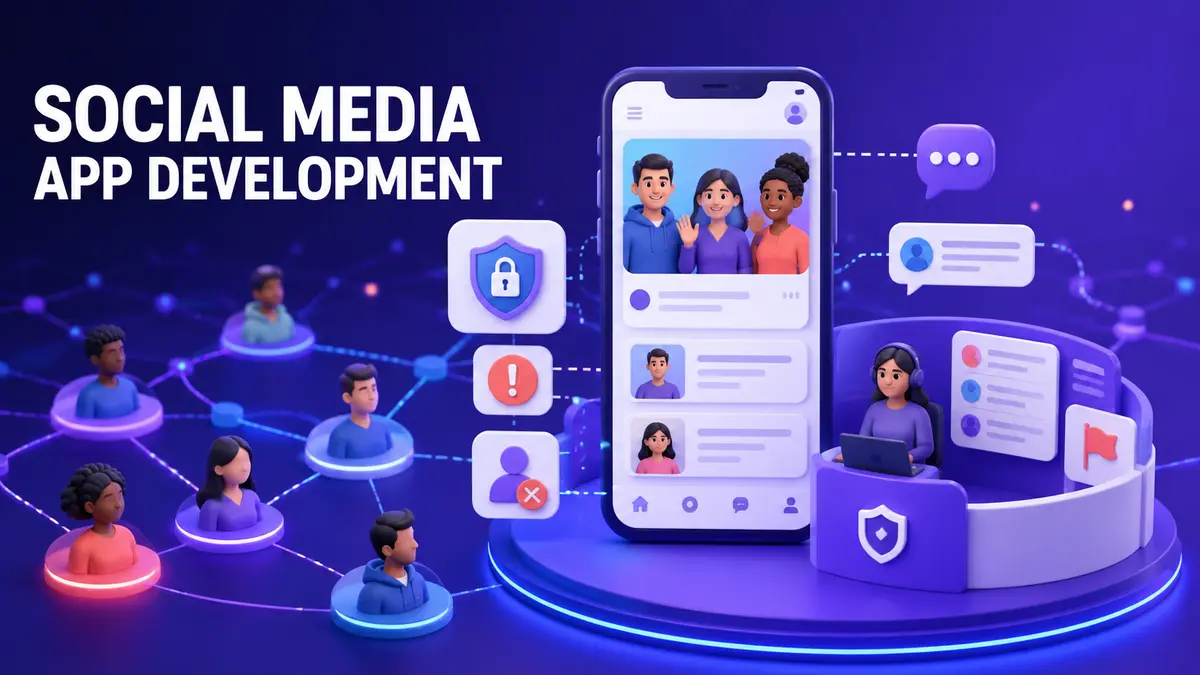
Quick answer Choose a social media app development company by evaluating more than interface design. The team should understand community behavior, user generated content, moderation, privacy, identity, messaging, notifications, scalable feeds, security, testing and long term operations. Ask how it will protect users and administrators when content volume grows or harmful behavior appears.
A social product is an operating system for relationships and content. Its rules, tools and incentives shape the community as much as the visual experience does.
State who the product serves, why members will return and what healthy participation looks like. A professional network, neighborhood group, creator community and private customer forum require different identity, discovery and moderation choices.
Choose a focused first community. Broad products face a cold start because people find little value before enough relevant content and relationships exist.
Map how a member discovers value, creates or responds to content, receives feedback and returns. The loop might involve following topics, joining groups, sharing expertise, messaging peers or collaborating around events.
Measure meaningful participation rather than only screen time. Useful measures may include completed connections, helpful responses, retained contributors and successful moderation.
Decide whether the community uses real names, verified identities, organization membership, pseudonyms or a mixture. The model affects safety, privacy, onboarding and trust.
Use secure authentication and recovery. Protect email changes, password resets and administrative actions. Give members control over profile visibility and explain which activity is public.
Define prohibited content and behavior before opening participation. Provide reporting, blocking, review queues, evidence, decisions and appeals suitable for the community. Moderation cannot depend on developers manually inspecting a database.
The Google Play user generated content policy describes requirements such as terms, reporting, blocking and ongoing moderation for applicable apps. Store rules are a baseline. The product also needs policies and staffing suited to its users and risks.
Support clear drafts, upload progress, failure recovery and deletion. Validate file types and limits on the server. Scan or process media in isolated services where appropriate and avoid exposing internal storage paths.
Give members control over who can view, comment, share or contact them. Make consequential settings understandable at the point of creation.
A chronological feed is easy to explain. A ranked feed can surface relevant content but needs signals, safeguards and monitoring. Group, topic and relationship feeds may create more focused value than one global stream.
Ask the development company to explain pagination, caching, duplicate prevention and content removal. Deleted or blocked content should disappear consistently across feeds, search and notifications.
Direct messages can increase connection and abuse risk. Decide who can start a conversation, how message requests work and how members block or report another account. Protect media, links and notifications.
Plan delivery, read state, retries and multi device synchronization. Users should understand whether a message is sending, failed or delivered.
Separate security, relationship, content and promotional notifications. Ask for permission after demonstrating value and provide category controls. Avoid loops that pressure users through misleading urgency.
Our guide to push messaging explains delivery, permissions and measurement choices.
Collect only the information needed for the service. Enforce authorization on the server for profiles, posts, groups, messages and administrative tools. Audit analytics and external software development kits that receive member data.
Plan export, deletion, retention and legal requests. Administrative access should use named identities, strong authentication and detailed audit records.
Support text resizing, meaningful labels, keyboard access where relevant, captions and alternatives for visual content. Do not communicate status, verification or errors through color alone.
Creation and moderation tools must also be accessible. A member should be able to report harmful content or control privacy with assistive technology.
Separate essential domains such as identity, content, relationships, media, messaging and notifications with clear contracts. A modular design can begin in one deployable application and evolve as load or ownership changes.
Ask how the team will monitor latency, queue delay, failed media processing and database pressure. Our mobile app backend guide covers reliability and ownership.
Normal product testing is not enough. Test abuse cases, administrative tools and recovery before the community grows.
Request evidence from products with user accounts, content and ongoing operations. Meet the product, backend, mobile, quality and security leads. Ask who owns moderation tools and incident support.
Proposals should include discovery, design, engineering, testing, launch, monitoring and maintenance. Our guide to choosing an app programming company provides a broader vendor scorecard.
Yes. The process can match the community size, but terms, reporting, blocking and accountable review should exist before harmful behavior occurs.
It can be. Choose the model that supports the community purpose and explain ranked behavior when it affects what members see.
Product, policy, operations and engineering share responsibility. A development company can build tools, while the business must own rules and decisions.
Techfusion Gear designs social products with participation, safety, privacy and scalable operations considered from the beginning. To discuss your community product, contact Techfusion Gear.