

Last updated: July 2026
The food delivery market changes faster than most “top apps” lists. Platforms merge, leave markets, add grocery and retail delivery, introduce subscriptions, and redesign how restaurants, couriers, and customers interact. A list published a few years ago may still include brands that are no longer meaningful standalone choices while missing the multi-category platforms shaping the market today.
This guide reviews the top food delivery apps in 2026 from two perspectives. Consumers can compare the platforms’ strongest use cases, while restaurant owners, startups, and product teams can study the product decisions behind their growth. The article also explains the business models, must-have features, technology architecture, development cost, and launch strategy required to build a modern on-demand food delivery platform.
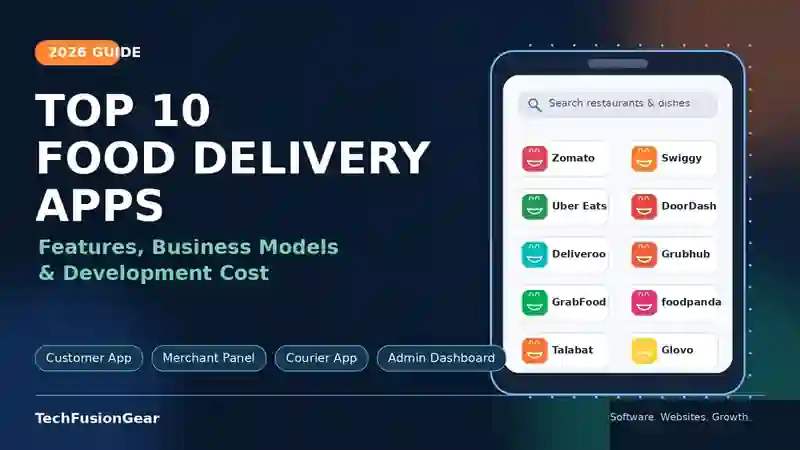
Quick answer: Ten major food delivery platforms worth studying in 2026 are Zomato, Swiggy, Uber Eats, DoorDash, Deliveroo, Grubhub, GrabFood, foodpanda, Talabat, and Glovo. This is not a universal market-share ranking because availability differs by country. The selection is based on regional importance, marketplace maturity, logistics capability, product breadth, and the lessons each platform offers to businesses building delivery products.
“Top” does not mean the same thing in every market. Zomato and Swiggy are central to the Indian market, DoorDash and Grubhub are important in the United States, Deliveroo has strong recognition in selected European and international markets, and Talabat is a major reference point in the Middle East. A global list should therefore compare product maturity and regional relevance rather than pretend that one app is best everywhere.
We evaluated the platforms using five practical criteria:
The apps are presented as major platforms to study, not as a precise one-to-ten market-share table.
| App | Core region | Best known for | Key business lesson |
|---|---|---|---|
| Zomato | India | Restaurant discovery, delivery, dining and loyalty | Combine discovery, transactions and repeat-use benefits |
| Swiggy | India | Food delivery, quick commerce and a broad convenience ecosystem | Increase customer frequency through adjacent services |
| Uber Eats | Multiple international markets | Food, grocery and retail delivery connected to Uber’s platform | Reuse identity, payments, maps and courier infrastructure |
| DoorDash | United States and selected international markets | Local commerce across restaurants, grocery, convenience and retail | Expand from food delivery into a neighborhood commerce platform |
| Deliveroo | United Kingdom and selected international markets | Hyperlocal logistics, restaurant partnerships and grocery | Use operational data to improve dispatch and delivery estimates |
| Grubhub | United States | Restaurant marketplace, campus, corporate and catering use cases | Build specialized channels around high-frequency customer groups |
| GrabFood | Southeast Asia | Food delivery inside a regional super-app | Cross-sell delivery, payments, mobility and merchant services |
| foodpanda | Asian markets | Food and grocery delivery with strong local-market adaptation | Localize payments, cuisine discovery and operations market by market |
| Talabat | Middle East | Regional ordering, scheduled delivery and localized payments | Localization is a product requirement, not a translation task |
| Glovo | Europe, Central Asia and Africa | Multi-category urban delivery | Design the platform around local commerce, not restaurants alone |
Zomato remains one of the defining food delivery products in India. Its consumer proposition extends beyond placing an order: users can discover restaurants, browse menus, use curated collections, schedule orders, access dietary modes, find offers, and use dining-related benefits.
Zomato’s website states that its platform covers more than 300,000 restaurants across 800-plus cities and has delivered more than three billion orders. Those numbers can change, but they illustrate the scale required to operate restaurant data, payments, customer support, promotions, courier logistics, and service reliability across a large and diverse market.
Standout capabilities:
Business lesson: A food delivery product becomes more defensible when it owns the full decision journey—from “What should I eat?” to payment, delivery, dining benefits, and repeat purchase.
Swiggy is another major Indian platform and a useful case study in expanding beyond restaurant delivery. Its ecosystem combines food ordering with quick commerce, dining-related services and other convenience use cases.
The product lesson is not simply to add more categories. The stronger strategic idea is frequency. Customers may order restaurant food a few times per month, while groceries and urgent household items can create more frequent app usage. Shared accounts, payments, addresses, notifications and delivery infrastructure make these services easier to cross-sell.
Standout capabilities:
Business lesson: Build adjacent services only when they reuse meaningful platform assets such as customers, couriers, merchants, payments, location data or support operations.
Uber Eats operates in numerous international markets and supports restaurant delivery, pickup, grocery shopping and selected retail categories. Its strongest structural advantage is integration with the wider Uber ecosystem.
The platform can reuse identity, saved payment methods, mapping, driver and courier systems, fraud controls, customer support infrastructure, and a globally recognized consumer account. This reduces friction for customers who already use Uber for mobility.
Standout capabilities:
Business lesson: A platform can scale faster when new products share foundational services. Startups should design reusable modules for authentication, payments, maps, notifications, promotions and support rather than rebuilding them for every vertical.
DoorDash describes itself as a local commerce platform rather than only a restaurant delivery app. Its marketplace includes restaurants, grocery stores, convenience stores, pet stores and other retailers. DoorDash also provides pickup, direct online ordering, business meals, merchant marketing and courier earning opportunities.
The company states that it has expanded to more than 40 countries through its wider international presence, including Deliveroo and Wolt. Consumers can track orders in real time, and features such as subscriptions and multi-store ordering are designed to increase convenience and order frequency.
Standout capabilities:
Business lesson: The restaurant order is only one local-commerce transaction. Once dispatch, payments and consumer demand are established, the same platform can serve grocery, convenience, pharmacy and retail categories.
Deliveroo operates a three-sided marketplace connecting consumers, restaurant and grocery partners, and riders. The company says it operates in 10 markets and works with approximately 160,000 restaurant and grocery partners.
Deliveroo is particularly valuable as an operations case study. Its logistics systems use data to estimate preparation time, travel time and local delivery conditions. The platform also developed delivery-only kitchen concepts and rapid grocery services.
Standout capabilities:
Business lesson: A delivery app is an operations system disguised as a consumer interface. Reliable preparation estimates, rider assignment and route decisions matter as much as attractive screens.
Grubhub is a major United States restaurant marketplace. The company states that its platform features approximately 415,000 merchants across more than 4,000 U.S. cities.
Grubhub demonstrates the value of specialized distribution channels. In addition to consumer ordering, it supports corporate accounts, catering, universities and campus dining use cases. These segments can produce recurring demand and operational patterns that differ from ordinary household orders.
Standout capabilities:
Business lesson: Do not treat every customer segment identically. Campus, office, event, hospital and residential delivery may require different menus, permissions, delivery locations, billing and support workflows.
GrabFood is integrated into Grab’s Southeast Asian super-app ecosystem. Depending on the market, Grab connects food delivery with mobility, digital payments, grocery delivery, parcel delivery, merchant services, advertising and financial products.
GrabFood supports delivery, pickup, scheduled orders and dine-out offers in selected markets. The app also uses different delivery-speed and price options, illustrating how delivery urgency can be productized rather than treated as one fixed service level.
Standout capabilities:
Business lesson: Delivery speed is not binary. Customers may choose economy, standard or priority fulfillment when the app clearly communicates the price and estimated time trade-off.
foodpanda is a long-running food and grocery delivery brand across several Asian markets. Its relevance is strongly regional: the app’s availability, payment methods, merchant mix and service categories differ by country.
That regional variation is precisely why foodpanda is useful to study. A delivery product cannot succeed through translation alone. It must adapt to local cuisine discovery, cash and digital payment preferences, address formats, density, rider economics, restaurant technology and customer-support expectations.
Standout capabilities:
Business lesson: International expansion is a sequence of local launches. Product rules, payments, merchant onboarding and support should be configurable by market rather than hard-coded globally.
Talabat is a major food ordering platform in the Middle East. Its official site says it operates across seven countries: Kuwait, Saudi Arabia, the United Arab Emirates, Oman, Bahrain, Qatar and Jordan.
Talabat’s consumer features include cuisine and area filters, menu images, order customization, online and cash payments, immediate or scheduled delivery, saved addresses, ratings and live customer support. These capabilities reflect the practical needs of a regional marketplace with diverse customer preferences.
Standout capabilities:
Business lesson: Localization includes payment behavior, address quality, language direction, customer support hours, dietary expectations and restaurant operations—not only translated labels.
Glovo positions itself as a city marketplace that can provide access to many types of local goods, not just meals. Its corporate site states that it operates in 22 countries and connects customers with local stores and couriers across Europe, Central Asia and Africa.
The multi-category model makes Glovo a useful reference for startups considering food, grocery, pharmacy, retail and parcel delivery within one platform. The benefit is a larger addressable market; the challenge is that every category introduces different inventory, packaging, preparation and fulfillment rules.
Standout capabilities:
Business lesson: Multi-category platforms need a flexible catalog and fulfillment engine. A pizza, prescription, grocery basket and parcel cannot share identical availability, substitution and delivery logic.
Older articles frequently list Scootsy and Postmates as independent leading food delivery apps. That framing is no longer useful for a current comparison.
This is why businesses should not copy an old feature list when planning a new product. The category has evolved from “browse restaurants and place an order” into a real-time local-commerce operating system.
A production food delivery platform is normally a connected system of at least four products.
The customer app handles location, restaurant discovery, search, menus, customization, cart, offers, checkout, payment, order tracking, ratings, support and account management.
Restaurants need onboarding, operating hours, menus, item availability, pricing, taxes, preparation-time controls, order acceptance, cancellations, promotions, payouts, performance reports and support.
The courier product requires identity verification, availability, order offers, pickup navigation, delivery navigation, customer communication, proof of delivery, earnings, incentives, safety tools and issue reporting.
The platform team needs merchant approval, service areas, commissions, delivery fees, promotions, refunds, fraud review, courier supply, live order monitoring, support tools, financial reconciliation, reports and role-based access.
These interfaces are connected by backend services for authentication, catalogs, inventory, orders, dispatching, pricing, payments, notifications, location data, analytics and customer support.
AI should solve measurable operational problems rather than exist as a marketing label. Valuable applications include personalized restaurant ranking, search understanding, preparation-time prediction, courier assignment, route optimization, demand forecasting, fraud detection, customer-support triage and promotion targeting.
Human review remains important for refunds, food safety, courier incidents, merchant disputes and unusual fraud cases.
The platform connects customers with restaurants and may rely on restaurants for delivery. This is simpler operationally but gives the platform less control over delivery quality.
The platform manages courier dispatch and the last mile. This improves standardization and market coverage but requires real-time operations, courier supply and support.
A restaurant or chain uses its own branded app. It retains customer data and reduces marketplace dependency, but must create demand and manage logistics itself or integrate a delivery-as-a-service partner.
The business controls food production and sells through one or more delivery channels. Success depends on menu economics, preparation consistency, local demand and delivery radius.
The platform delivers meals, groceries, convenience goods, pharmacy items, retail products and parcels. This increases frequency but makes catalog, availability and fulfillment logic more complex.
A sustainable model should calculate contribution margin per order after courier cost, discounts, refunds, payment fees, support and promotional spending. Gross order value alone does not prove profitability.
Early-stage products do not need the same architecture as DoorDash or Uber Eats. They do need clear boundaries so the system can grow without a complete rewrite.
As volume grows, dispatching, location updates, notifications, search, promotions and financial reconciliation may need separate services and queues. Real-time order events should be designed to be idempotent so retries do not create duplicate charges, orders or payouts.
Food delivery software costs more than a standard business app because it includes several user roles, real-time location, payments, dispatching, support and operations controls.
| Product level | Indicative development range | Typical scope |
|---|---|---|
| Focused MVP | ₹4 lakh to ₹8 lakh | Customer app, basic merchant panel, admin dashboard, manual or simple courier workflow, one city |
| Growth-ready platform | ₹8 lakh to ₹18 lakh | Customer and courier apps, merchant panel, live tracking, payments, promotions, reports and stronger operations |
| Multi-city custom platform | ₹18 lakh to ₹40 lakh+ | Advanced dispatch, multiple zones, automated settlements, integrations, analytics, support tools and scalable infrastructure |
These are planning ranges, not fixed quotations. Final cost depends on the number of apps, user roles, design depth, real-time tracking, dispatch rules, payment methods, restaurant integrations, delivery zones, languages, analytics, security and expected scale.
A restaurant-owned ordering app is usually less expensive than a multi-vendor marketplace because it has fewer merchants, commissions and settlement workflows. A platform supporting multiple cities, categories and courier models can exceed the ranges above.
For a broader comparison of Flutter, React Native and native development budgets, read our mobile app development cost guide for India.
For many delivery businesses, operations and customer acquisition eventually cost more than the initial software build. Budget planning should include at least 12 months of launch and operating expenses.
Do not begin with “build the next Zomato.” Define a specific launch market, customer type and reason to switch. Examples include late-night delivery, office meals, healthy subscriptions, regional cuisine, campus delivery, restaurant-owned delivery, or underserved local areas.
A polished customer app has little value without reliable merchant selection and delivery capacity. Interview restaurants, model commissions, test preparation times and understand courier economics before development is complete.
Decide who delivers, how couriers are paid, how far orders can travel, how cancellations work, how cash orders are handled and who absorbs refunds. These decisions determine the software rules.
Launch with the minimum workflow needed to complete and support real orders. Avoid complex loyalty, artificial intelligence and multi-category features until the core order cycle is reliable.
Start with a limited zone, manageable restaurant group and defined operating hours. Measure acceptance rate, preparation time, courier wait time, delivery time, cancellations, refunds, support contacts, repeat rate and contribution margin.
Expansion multiplies weaknesses. Fix menu accuracy, restaurant response times, courier supply, address quality and support workflows before adding new cities.
After order reliability is stable, introduce memberships, personalized discovery, sponsored placement, referrals, scheduled delivery, subscriptions or adjacent categories based on actual customer behavior.
TechFusionGear designs and develops mobile apps, web platforms, admin dashboards and custom business software for startups and growing companies. For a food delivery project, we can help with product discovery, user flows, Flutter or native app development, restaurant and courier panels, backend APIs, payment integration, maps, tracking, dashboards, deployment and post-launch support.
Our approach starts with the operating model rather than a copied feature checklist. We define how orders, merchants, couriers, service zones, fees, refunds and settlements should work before turning them into software.
Review our software and digital services, or contact TechFusionGear to discuss a food delivery app, restaurant ordering system or local-commerce marketplace.
There is no single best app worldwide. Zomato and Swiggy are major choices in India, DoorDash and Grubhub are important in the United States, GrabFood and foodpanda serve Asian markets, Talabat is prominent in the Middle East, and availability for Uber Eats, Deliveroo and Glovo varies by country.
Zomato and Swiggy are the two primary nationwide food delivery platforms to compare in India. Local restaurant apps, quick-commerce services and direct ordering platforms may also be relevant depending on the city and use case.
foodpanda remains active in several Asian markets, but it is not a major active food delivery platform in India. Users should check the company’s current country-specific availability.
Uber acquired Postmates in 2020. The Postmates brand may still appear in selected contexts, but it is part of Uber, so Uber Eats is generally the more useful independent platform for current market comparison.
A focused one-city MVP may begin around ₹4 lakh to ₹8 lakh in India. A stronger multi-role platform with customer and courier apps, restaurant tools, live tracking, payments and operations dashboards may cost ₹8 lakh to ₹18 lakh. Multi-city platforms with advanced dispatch, settlement and analytics can reach ₹18 lakh to ₹40 lakh or more.
A focused MVP commonly requires approximately three to five months. A more complete platform can require six to twelve months, depending on scope, integrations, quality assurance, pilot feedback and operational readiness.
Yes. Flutter can be a practical choice for customer and courier apps because it supports Android and iOS from one codebase. Backend architecture, maps, location tracking and operational design remain equally important to performance.
The essential modules are a customer app, restaurant or merchant panel, courier app and admin operations dashboard. They require shared backend services for catalogs, orders, dispatching, payments, notifications, support, analytics and settlements.
Common revenue sources include restaurant commissions, delivery and service fees, subscriptions, small-order or priority fees, advertising, sponsored placement, restaurant software and merchant services.
Aggregators provide immediate customer reach but charge commissions and control much of the customer relationship. A restaurant-owned app provides more control and first-party data but requires marketing, technology and delivery operations. Many restaurants use both.
The strongest food delivery apps in 2026 are not merely ordering interfaces. They are marketplaces, logistics systems, payment products, merchant platforms and customer-retention engines operating in real time.
Businesses planning a new delivery product should study the major platforms without copying them blindly. Select one market, define a differentiated operating model, build a focused MVP, validate order economics and expand only after the core service is reliable.