

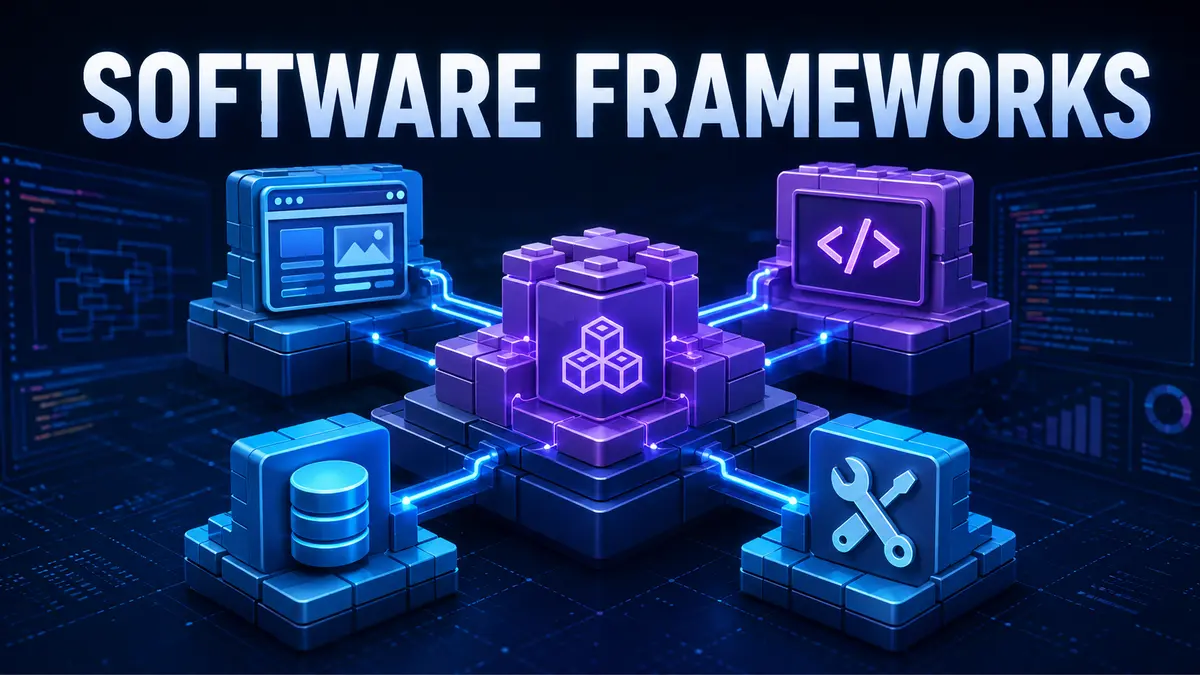
A software framework is a reusable structure for building applications. It provides conventions, ready-made components and a defined way for different parts of the software to work together. Developers add the business-specific features while the framework handles common concerns such as routing, configuration, security hooks, database access and error handling.
The main value of a framework is consistency. Instead of deciding how every new feature should be organized, a team works within an established architecture. This can improve development speed, testing and maintainability when the framework fits the problem.
A framework usually controls the overall flow of an application. It calls the code written by developers at expected points. This pattern is sometimes described as inversion of control. The application follows the framework lifecycle rather than assembling every operation manually.
For example, a web framework may receive a browser request, match it to a route, call a controller, retrieve data, render a response and handle errors. The developer writes the rules for a particular product, but the framework coordinates the sequence.
Not every framework includes all these elements. Some focus on user interfaces, some on server-side development and others on mobile applications, data processing or automated testing.
A library is a collection of functions or components that application code calls when needed. A framework normally provides the surrounding structure and calls application code according to its lifecycle. The distinction is about control more than size.
A team can use several libraries inside one framework. For instance, the framework might manage routing and application state while libraries handle date formatting, charts or file processing. Both reduce repeated work, but they shape a project in different ways.
A platform is the broader environment where software runs or is delivered. It may include operating systems, hosting, databases, deployment services and development tools. A framework is usually one layer within that environment.
The same framework can often run on several platforms. Conversely, one cloud or mobile platform may support many frameworks. Understanding this difference helps buyers avoid comparing products that solve different parts of the technology stack.
Frameworks reduce the amount of basic code a team must create and maintain. Shared conventions also make reviews easier because developers know where functionality should live. Mature frameworks often include tested solutions for common security and reliability needs.
They can also make hiring and onboarding easier. A developer familiar with the framework can understand a new project more quickly than a completely custom architecture. This benefit is strongest when the team follows documented conventions rather than overriding them everywhere.
A framework is not automatically the best choice. It can add unnecessary complexity to a small tool, restrict an unusual product requirement or create upgrade work when a project depends heavily on deprecated behavior.
Problems often appear when a team selects a framework for popularity rather than fit. A large ecosystem can be helpful, but it does not replace careful evaluation of performance, security, hosting, licensing, team skills and long-term support.
Describe the users, workflows, data, integrations, expected traffic, security needs and release schedule. The right framework is the one that supports these constraints with the least unnecessary complexity.
A technically strong framework may still be a poor choice if nobody can operate it confidently. Consider current skills, training time and the availability of experienced developers.
Review release frequency, support periods, upgrade guidance, security response and community activity. A framework becomes a long-term dependency, so maintainability matters as much as initial speed.
Test one realistic workflow that includes data, validation, permissions and an external integration. A focused prototype reveals friction that feature lists cannot show.
Include development, testing, hosting, monitoring, upgrades and specialist hiring. A fast first release can become expensive if routine changes require complex work.
Front-end frameworks help structure interactive browser interfaces. Back-end frameworks coordinate server logic, data access and APIs. Mobile frameworks support applications across mobile operating systems. Testing frameworks organize automated checks. Data frameworks support processing pipelines and analytical work.
A modern product may use more than one framework. The important question is whether each layer has a clear responsibility and can be upgraded without destabilizing the whole system.
A maintainable project keeps business rules separate from framework-specific code where practical. This makes testing easier and reduces the cost of future changes. The codebase should also have automated checks, documented conventions and a reliable upgrade process.
Our guide to custom software solutions explains how architecture decisions connect to cost, process and business value. Teams evaluating a delivery partner can also use our guide to choosing an enterprise software partner.
No. A programming language defines how instructions are written and executed. A framework uses a language and provides an organized structure for building a particular type of software.
No. Small scripts, highly specialized systems and simple tools may benefit from a lighter approach. The choice should follow product complexity and maintenance needs.
Yes, but the cost depends on how tightly the application is coupled to it. Clear architecture and good tests make gradual migration more practical.
A framework is valuable when it reduces repeated decisions and creates a stable path for development. TechFusion Gear designs custom web and software products around business needs, maintainability and future growth. Contact our team to evaluate the right architecture for your next application.