

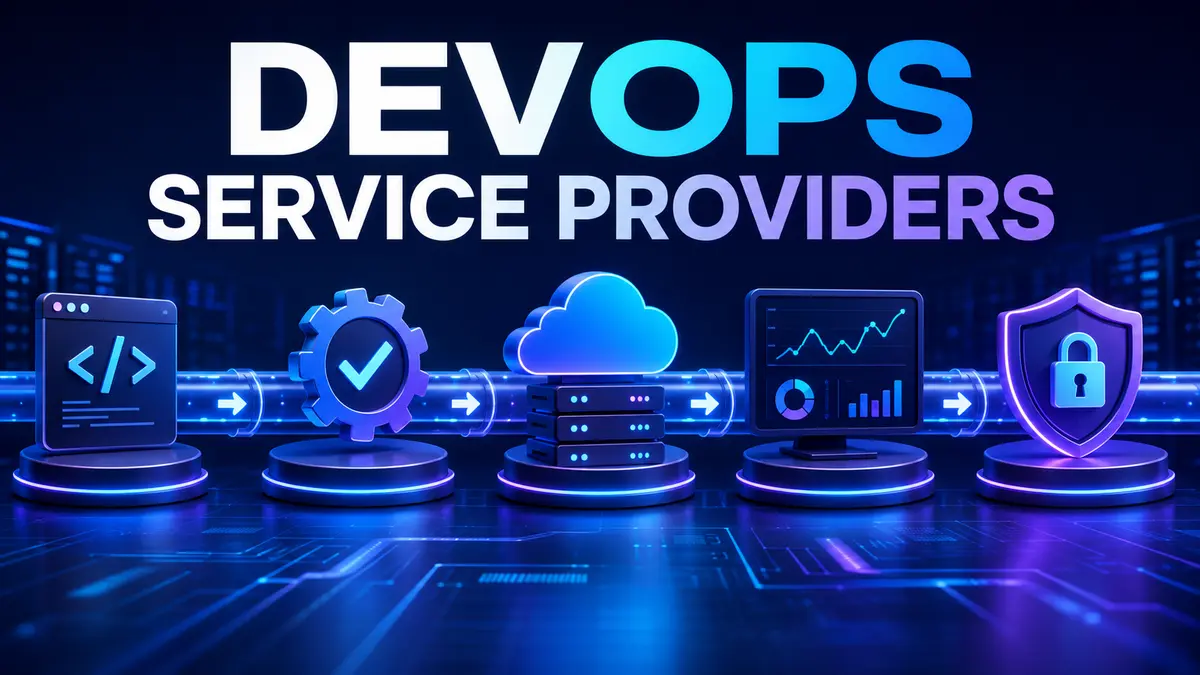
DevOps service providers help teams make software delivery faster, safer and more repeatable. They may design continuous delivery pipelines, automate infrastructure, improve cloud operations, strengthen monitoring and build incident-response practices.
The right provider should reduce operational dependence on manual work and individual memory. It should leave your team with documented systems, measurable reliability and the ability to understand how software reaches production.
DevOps is not a product that can be installed. Begin with the delivery problem. Releases may be slow, environments may differ, incidents may take too long to diagnose or cloud costs may be difficult to control.
Define a small set of outcomes such as shorter release lead time, fewer failed deployments, faster recovery and more consistent environments. Tool decisions should support these outcomes.
Some providers focus on projects, while others provide ongoing managed operations. Clarify whether you are buying a defined transformation, regular engineering capacity or an accountable service.
A credible provider begins by mapping how code is planned, reviewed, tested, approved, deployed and monitored. It should identify manual steps, unstable dependencies, missing controls and unclear ownership.
The assessment should produce a prioritized plan. Trying to automate every step at once can delay value and hide the most important risk.
A delivery pipeline should build software consistently, run appropriate tests, record artifacts and control deployment. Important branches and production releases need clear approvals and traceability.
Ask how the pipeline handles failure and rollback. Speed without recovery creates fragile delivery. The provider should also explain how credentials and signing keys are protected.
Infrastructure as code makes environments reproducible and reviewable. Changes can follow the same version control and approval practices as application code. This reduces configuration drift and makes recovery easier.
The provider should organize reusable modules carefully and avoid hiding essential knowledge inside proprietary scripts. Your team needs access to the code and instructions required to rebuild the environment.
Cloud work may cover accounts, networks, compute, storage, databases, identity, budgets and recovery. Architecture must reflect availability, data, security and cost requirements.
Our cloud consulting services guide explains how discovery, migration and operating models fit together. A DevOps provider should connect delivery automation with the wider cloud governance plan.
Monitoring should help teams detect and understand user impact. Useful signals include availability, errors, latency, capacity and important business transactions. Logs and traces can provide deeper context when an incident crosses several services.
Ask who receives alerts, how priorities are assigned and how noise is removed. A dashboard without an operational response process creates visibility but not reliability.
Security checks should be built into development and release workflows. These may cover dependency risk, secrets, container images, infrastructure changes and permissions.
Automation should support judgment rather than create uncontrolled blocking. The provider needs a process for reviewing findings, approving exceptions and tracking unresolved risk.
The service should define who leads incidents, how communication works and how restoration decisions are made. Runbooks should cover common failures and important recovery procedures.
After serious incidents, a review should identify technical and process improvements without focusing only on individual blame. Actions need owners and completion dates.
Useful delivery measures include change lead time, deployment frequency, failed change rate and restoration time. Reliability measures may include service availability, error levels and incident recurrence.
Do not optimize one measure in isolation. More deployments are not helpful if quality falls, and perfect stability can hide a delivery process that never changes.
A fixed project can suit a clear assessment or pipeline implementation. Retained capacity may fit an evolving platform. Managed services can support continuous operations when scope and service levels are defined.
Compare assumptions about cloud fees, monitoring tools, after-hours response, migrations and application changes. Ask who may authorize work outside scope.
For wider supplier evaluation, use our guide to choosing an enterprise software partner.
No. It improves how development and operations collaborate through shared ownership, automation, feedback and reliable processes.
A focused improvement can show value quickly, but sustainable change depends on application architecture, current practices and team adoption.
It can, provided access, service levels, incident ownership, documentation and customer governance are clearly defined.
TechFusion Gear helps businesses create reliable delivery pipelines, cloud operations and maintainable software practices. Contact our team to assess your current release process and prioritize the highest-value improvements.