

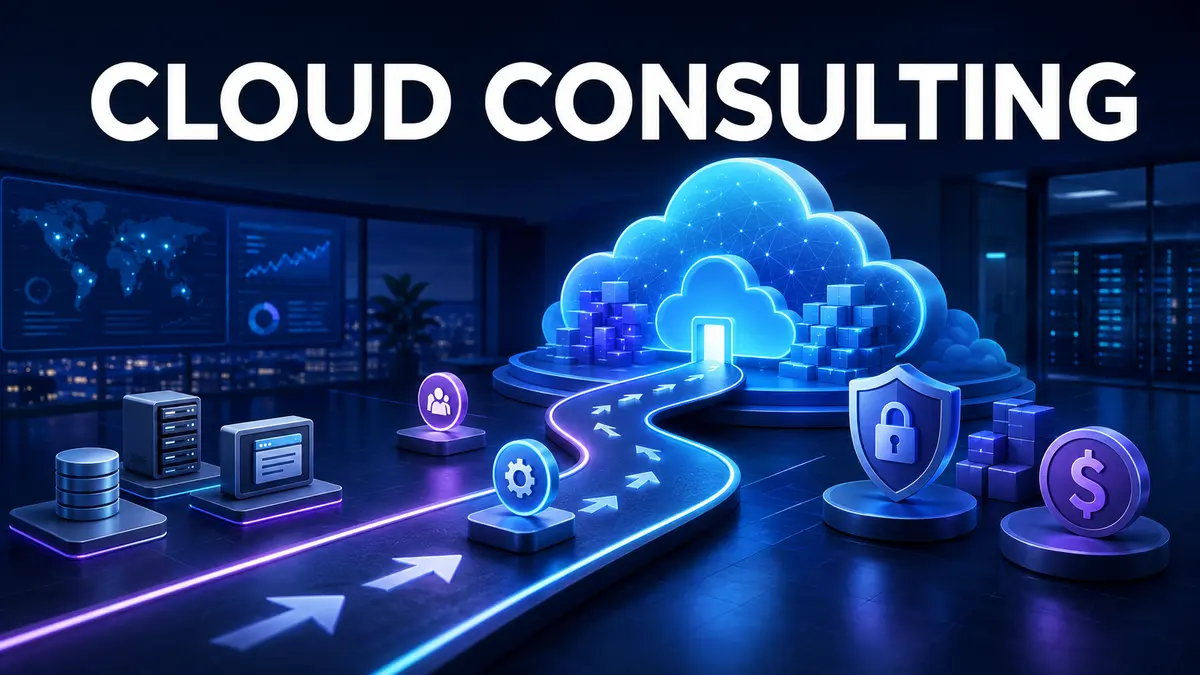
Cloud consulting helps a business plan, build, migrate and operate technology in a cloud environment. A consultant should connect technical decisions to business outcomes such as faster delivery, reliable recovery, secure remote access and more flexible capacity. The work may cover strategy, architecture, migration, security, cost management and ongoing improvement.
The best provider is not simply the one with the longest service list. It is the team that can explain tradeoffs, document decisions and leave your organization with a cloud environment it can understand and govern.
Cloud consulting can begin before any migration. A discovery phase reviews applications, data, integrations, contracts, security controls, operating costs and internal skills. The result should be a prioritized roadmap rather than a generic recommendation to move everything.
Common services include cloud readiness assessment, target architecture, workload migration, identity design, backup and recovery, security improvement, performance tuning, cost optimization and operational support.
A useful strategy identifies why the business is considering cloud services. Possible goals include reducing deployment delays, improving resilience, supporting distributed teams, modernizing legacy systems or expanding into new markets.
Readiness assessment then tests whether the applications, data, network and team can support those goals. Some systems may be ready to move with limited change. Others may need redesign, replacement or a longer period of hybrid operation.
Cloud architecture defines how applications, data, identities, networks and monitoring fit together. It should account for availability needs, recovery targets, data location, compliance, performance and growth.
A consultant may recommend one provider, several providers or a hybrid design. Each option adds benefits and operating complexity. Multi-cloud designs can reduce dependence on one supplier in some cases, but they also require broader skills, duplicated controls and more complex troubleshooting. The decision should follow a clear business need.
A cloud migration is a sequence of controlled changes. Workloads should be grouped by dependency and risk. Low-risk systems may move first to test the process, while critical systems require detailed rehearsal and rollback plans.
The migration is not complete when a server starts in the cloud. The business must verify that users, integrations, security controls and support processes work as expected.
Cloud security is a shared responsibility. The provider secures the underlying service according to its model, while the customer remains responsible for areas such as identities, data, configuration and application behavior.
A consultant should design access around roles, strong authentication and minimal privilege. Logging should cover administrative actions and important data events. Security reviews should also examine exposed services, encryption, backup protection, secrets management and incident response.
Ask how recommendations will be documented and how exceptions will be approved. A secure design can weaken quickly when temporary access and manual changes are not governed.
Cloud spending is variable by design, so cost control needs continuous ownership. A provider should establish account structure, budgets, alerts, resource tags and review routines. Teams also need to understand which design choices create recurring charges.
Cost optimization should protect performance and resilience. Removing an apparently idle resource without understanding dependencies can create an outage. Good consultants connect each recommendation to technical impact and business priority.
Cloud environments need monitoring for availability, performance, security and spending. Alerts should reach named owners and include clear response instructions. Backup policies should define what is protected, how long data is retained and how restoration is tested.
Recovery planning should focus on real business services, not only individual servers. An application may depend on identity, network, database, storage and third party services. All required components must be included in recovery tests.
A credible provider asks about business goals, application dependencies, risk and team capability before recommending an architecture.
The proposal should name the documents, diagrams, configurations, test results and training your team will receive. Verbal knowledge is difficult to retain.
Ask how access is controlled, how changes are reviewed and how incidents are handled. Provider staff may hold powerful access, so their operating discipline matters.
The arrangement should improve internal understanding. Runbooks, workshops and paired operations help prevent long-term dependence on one supplier.
Clarify which cloud fees are paid directly, which services are fixed, what counts as additional work and how architecture changes are approved.
A strong engagement usually moves through discovery, roadmap, design, proof of concept, controlled migration and operational improvement. Decision records should capture major tradeoffs. Progress reviews should measure business outcomes as well as completed technical tasks.
Cloud projects often connect with custom applications and business systems. Our guide to custom software solutions explains how to assess cost, process and expected value. For broader partner selection, read our guide to choosing an enterprise software partner.
No. It can include strategy, architecture, security, cost control, modernization, monitoring, recovery and ongoing governance.
No. Each workload should be evaluated for business value, technical fit, risk, dependencies and total ownership effort.
Use clear account ownership, resource tags, budgets, alerts, regular reviews and architecture decisions that consider recurring usage costs.
TechFusion Gear helps businesses connect cloud decisions to secure software, dependable operations and measurable growth. Contact our team to assess your current environment and create a practical roadmap for migration or modernization.