

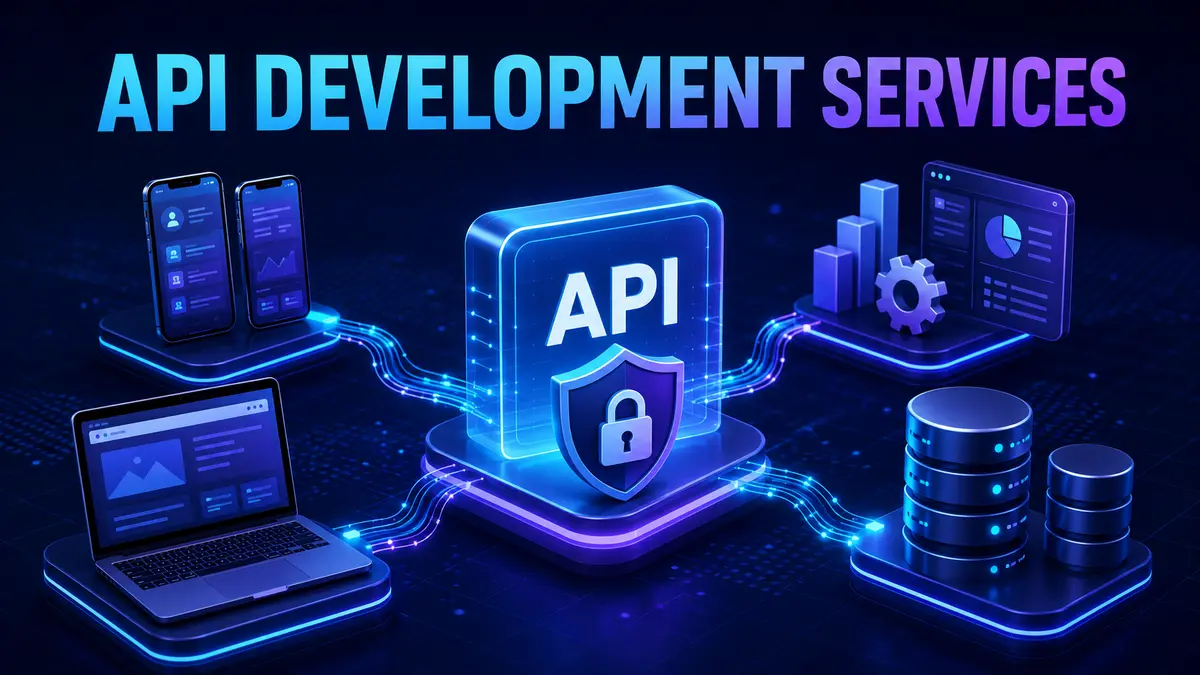
API development services design and build secure connections between applications, websites, mobile products, databases and third party platforms. A good API turns business capabilities into clear, controlled interfaces that other software can use reliably.
The work includes more than writing endpoints. It covers requirements, data models, authentication, permissions, documentation, testing, monitoring, deployment and long-term version management. These activities determine whether an integration remains dependable after launch.
An application programming interface defines how software requests information or actions from another system. It describes available operations, required inputs, returned data and possible errors. This agreement allows teams to integrate systems without exposing all internal implementation details.
For example, an ecommerce application may use APIs for products, inventory, customers, payments, shipping and notifications. Each connection needs clear rules about identity, data and failure handling.
Some engagements create a new API for an existing system. Others connect several APIs, replace a fragile legacy integration or build an integration layer that supports multiple products.
API design should begin with the user or operational outcome. Define which system owns each record, who may trigger an action, how quickly data must update and what happens when a dependency is unavailable.
This prevents the interface from becoming a collection of technical endpoints with no coherent product model. A business-first design also makes acceptance testing clearer because each API operation supports a known workflow.
REST is widely used for web and mobile integrations because it maps business resources to standard web operations. GraphQL can help clients request flexible data shapes from a defined schema. Event-driven interfaces publish changes so other systems can react asynchronously. Older enterprise environments may use SOAP where formal contracts and established tooling are important.
The right approach depends on consumers, data patterns, latency, security, existing systems and team capability. A development partner should explain why a style fits rather than selecting it only because it is familiar.
Names, request formats and responses should be consistent. Validation rules need useful error messages that help consumers correct a request. Pagination, filtering and sorting should follow predictable conventions.
An API contract should be documented before or alongside implementation. Machine-readable specifications can support documentation, client generation and automated tests. The contract becomes a shared reference for teams working on different systems.
Authentication confirms who is making a request. Authorization decides what that identity may do. Both need careful design. A valid account should not automatically receive access to every record or operation.
Security testing should include authorization failures, invalid input, replay scenarios, excessive requests and attempts to access another user’s data.
Every dependency can be slow or unavailable. The API should use sensible timeouts, controlled retries and clear failure responses. Repeating a request must not create duplicate payments, orders or records when the operation should happen only once.
For important workflows, teams should consider idempotency, queues, circuit breaking and reconciliation. The exact techniques vary, but the business should know how incomplete transactions will be detected and repaired.
Unit tests check individual components. Integration tests verify databases and dependent services. Contract tests confirm that providers and consumers agree on message formats. Performance tests examine behavior under expected and peak load.
Testing should include successful requests, invalid input, missing permissions, timeouts, duplicates and partial failures. A launch checklist should also verify monitoring, alerting, documentation and support ownership.
Useful documentation explains authentication, endpoints, request fields, response fields, errors, limits and example workflows. A quick-start guide should help a new developer make a safe test request with minimal guesswork.
Documentation must change with the API. Generating reference content from the contract can reduce drift, but business examples and migration notes still need active ownership.
APIs often support several consumers that cannot all update at the same time. Breaking changes need a versioning and deprecation policy. Consumers should receive notice, migration guidance and enough time to test.
Monitor usage by version and client where appropriate. This shows whether an older interface can be retired safely. Unused endpoints should not remain exposed indefinitely without an owner.
The partner should be able to discuss business workflows as comfortably as technical protocols. Our guide to custom software solutions explains how requirements, architecture and delivery affect cost. You can also review our advice for choosing an enterprise software partner.
Timing depends on workflow complexity, data quality, security, third party systems and testing. A small stable integration may be completed quickly, while a business-critical platform needs deeper discovery and staged release.
Often yes. A wrapper or integration layer can expose selected legacy capabilities, but data quality, performance and vendor restrictions must be assessed first.
Efficient design, stateless processing where suitable, caching, rate limits, reliable data services, monitoring and capacity testing all contribute to scalability.
TechFusion Gear designs custom APIs and system integrations with security, documentation and maintainability built into the delivery process. Contact our team to plan a new API, modernize a legacy connection or connect your business platforms.