

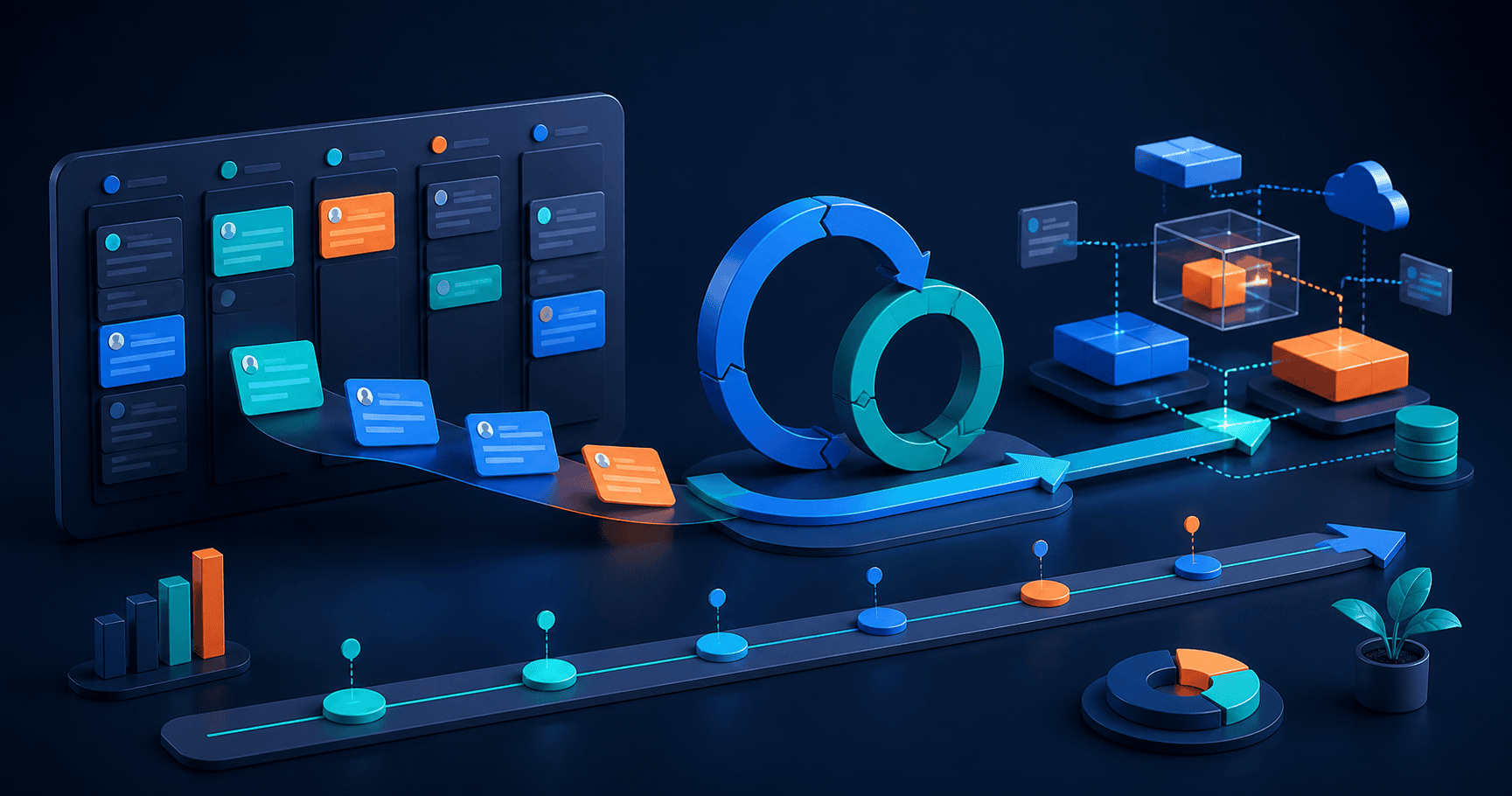
Software development process methodologies are the structured ways a team plans, builds, tests, releases, and improves software. The best approach depends on how clear the requirements are, how often priorities may change, the level of technical or compliance risk, and how closely business stakeholders need to be involved during delivery.
For most business software projects, the decision is not simply “Agile versus Waterfall.” A practical delivery plan often combines clear up-front discovery with short build-and-review cycles. This guide explains the main software development process methodologies and how to choose one that fits your project.
A methodology gives the project team a shared way to make decisions. It defines how requirements are collected, when designs are reviewed, how work is prioritised, when testing occurs, who approves a release, and how changes are handled. Without a clear process, projects can suffer from unclear scope, repeated rework, delayed feedback, and avoidable surprises near launch.
The methodology should support the business outcome—not force every project into the same routine. A simple customer portal, a custom CRM, an ecommerce integration, and a regulated internal system may all need different levels of planning and control.
Agile is an iterative approach. Rather than trying to define every feature before work begins, the team delivers the highest-value work in smaller increments, reviews it with stakeholders, and uses what it learns to plan the next increment.
Agile does not mean “no plan.” A good Agile project still needs clear goals, a prioritised backlog, agreed responsibilities, acceptance criteria, testing, and an approach to release management.
Scrum is a popular Agile framework that organises work into fixed, short cycles called sprints. A sprint often lasts one to four weeks. The team agrees on a small group of priorities, builds and tests them, then reviews the result with stakeholders before planning the next sprint.
For a custom software project, Scrum can help a business launch a useful first version without waiting for every future feature. For example, a CRM may begin with lead capture, follow-up workflows, and reporting before later adding deeper integrations or automation.
Waterfall is a more sequential process. The team completes requirements, design, development, testing, and deployment in defined phases. Changes can still happen, but they are managed formally because a change in one phase may affect the work already completed in another.
Waterfall can provide predictability, but it becomes risky when stakeholders do not see a working version until late in the project. If important assumptions are uncertain, include prototypes, design reviews, or staged demonstrations before committing to the full build.
Kanban manages work as a continuous flow. Tasks move through visible stages such as “to do,” “in progress,” “review,” “testing,” and “done.” Instead of planning a fixed sprint, the team limits the amount of work underway and pulls the next highest-priority task when capacity becomes available.
Kanban is particularly useful for website maintenance, bug fixes, performance work, small enhancements, integration changes, and ongoing technical support.
A hybrid method is often the most practical option for business software. The project begins with structured discovery: goals, users, workflows, integrations, risks, scope boundaries, and success measures. The detailed build then happens iteratively, with regular reviews and controlled changes.
This approach gives decision-makers enough clarity to plan budget and responsibilities while allowing the solution to improve as real screens, workflows, and testing results become available.
A process cannot replace clear business priorities, usable design, quality assurance, responsible deployment, or communication. The strongest projects align the methodology with the team, the technical risk, and the business outcome. They also keep scope visible and give stakeholders meaningful opportunities to review work before a full launch.
If you are planning a CRM, portal, dashboard, workflow system, or another tailored solution, read our custom software development guide for the cost, process, benefits, features, and ROI considerations. For projects centred on a website, web application, or integration, explore our custom web development services.
Techfusion Gear helps businesses clarify requirements, prioritise a first release, and choose a practical approach for custom software and web development. A short discovery conversation can surface the workflows, users, integrations, risks, and milestones that should shape the project.