

Last updated: July 2026
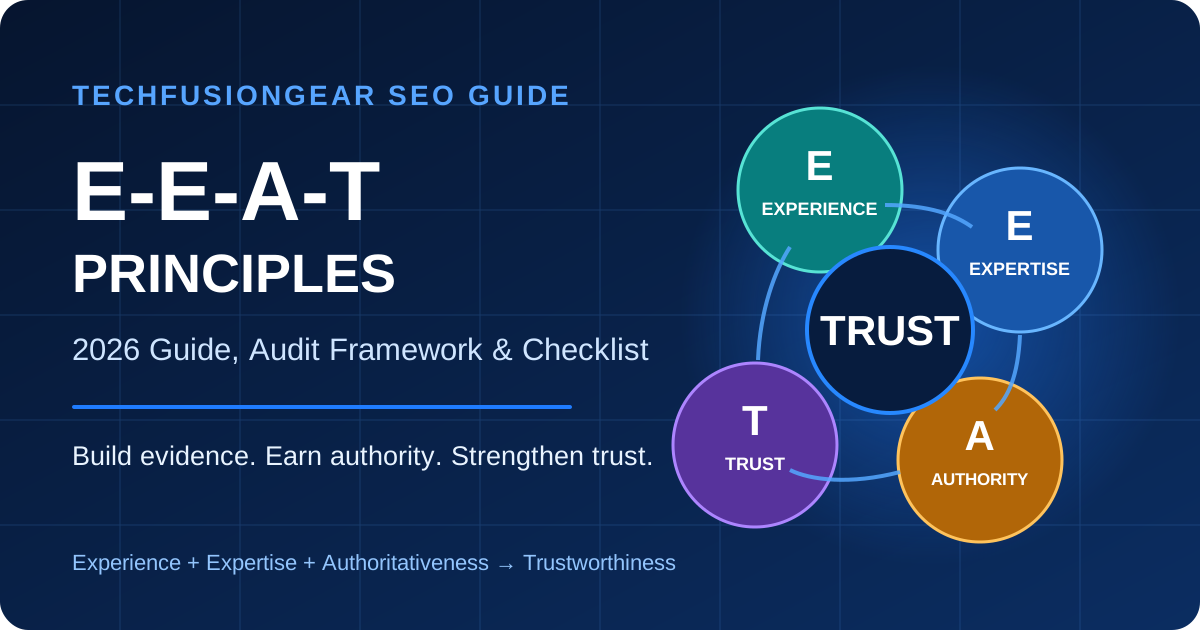
E-E-A-T principles are a practical way to evaluate whether content demonstrates real experience, credible expertise, recognized authority, and—most importantly—trust. The acronym stands for Experience, Expertise, Authoritativeness, and Trustworthiness.
Google does not describe E-E-A-T as a single score or a direct ranking factor. Instead, its automated ranking systems use many signals that can identify content with qualities associated with strong E-E-A-T. Google also states that trust is the most important element, while experience, expertise, and authority contribute to trust.
Quick answer: E-E-A-T is not a checklist that guarantees rankings. It is a quality framework. The practical goal is to make it easy for users—and the systems evaluating your pages—to understand who created the content, how it was produced, why the creator is qualified, what evidence supports it, and why the website can be trusted.
This guide goes beyond the acronym. It explains how E-E-A-T works at the creator, page, and website level; what evidence to publish; how to audit content with a 100-point internal framework; how AI-assisted content should be governed; and how a smaller business can compete with established publishers without pretending to have a decade of reputation.
Research methodology: TechFusionGear reviewed the 11-result SERP export supplied for the keyword “E-E-A-T principles.” The sample included Google’s official helpful-content documentation and large publishers such as Mailchimp, Semrush, Moz, Search Engine Journal, TopRank Marketing, and Siege Media. The repeated pattern was strong definitions and general improvement tips. The main opportunity was to add a transparent SERP analysis, implementation evidence, a site-versus-page model, a weighted audit, templates, AI controls, and a practical rollout plan. This SERP sample is a snapshot, not a permanent ranking record.
E-E-A-T is a quality concept used in Google’s Search Quality Rater Guidelines and helpful-content guidance. Quality raters evaluate whether search results appear helpful, reliable, and appropriate for the user’s intent. Their individual ratings do not directly change a page’s ranking. Google uses aggregated rater feedback to evaluate whether proposed changes to its systems produce better results.
Google’s official people-first content guidance says its systems identify a mix of factors that can help determine whether content demonstrates experience, expertise, authoritativeness, and trustworthiness. It also makes three points that are frequently misunderstood:
The framework should therefore change how content is researched, written, reviewed, published, and maintained. It should not be treated as a keyword-density technique.
Google added the first “E”—Experience—to the earlier E-A-T framework in December 2022. The addition recognized that first-hand use, observation, or participation can be valuable evidence. A person who has actually installed a platform, visited a location, operated a workflow, or tested a product can provide details that a generic summary cannot.
Experience and expertise can overlap, but they are not identical. Someone may have extensive lived experience without a formal credential. Someone else may have deep professional expertise without having used a particular product. The appropriate evidence depends on the page’s purpose.
Not as a single measurable factor. There is no public “E-E-A-T score,” no E-E-A-T meta tag, and no setting in Google Search Console that turns it on.
The more accurate explanation is:
This distinction matters because it prevents false optimization. Adding an author box to weak content does not create expertise. Publishing a trust badge does not make a business trustworthy. Adding ten references does not correct an unsupported conclusion. E-E-A-T is demonstrated by the full experience a user has with the creator, content, and website.
Google’s systems aim to prioritize helpful, reliable, people-first content. The same work that strengthens E-E-A-T usually improves real search performance because it creates better pages:
These improvements can also support visibility in AI-generated answers, because well-structured, attributable, evidence-based content is easier to quote, cite, and verify.
Experience is direct involvement with the subject. It answers: Has the creator actually done, used, visited, tested, built, operated, or lived through what they are discussing?
Useful experience evidence includes:
Experience is not demonstrated by repeatedly using phrases such as “in our experience.” The page needs evidence. For example, a software comparison becomes more useful when it explains the test environment, data volume, integrations, limitations, and why one option failed a particular requirement.
Expertise is the knowledge or skill required to create accurate, useful content for the page’s purpose. It answers: Does the creator understand the subject deeply enough to guide the reader responsibly?
Expertise may be demonstrated through:
Formal credentials are essential for some YMYL topics, but not for every page. A skilled WordPress developer may demonstrate expertise through documented implementations, code, performance tests, and project outcomes. A patient can offer valuable lived experience of a condition, but should not replace a qualified clinician for diagnosis or treatment guidance.
Authoritativeness is the extent to which the creator, content, or website is recognized as a useful source on the topic. It answers: Do relevant people and organizations treat this source as credible?
Authority is relational. A website does not become authoritative merely by describing itself that way. Common evidence includes:
Authority should be topic-specific. A large entertainment website is not automatically authoritative for medical advice. A local agency may be more authoritative for a detailed Ahmedabad implementation question than a global publisher with no local operational knowledge.
Trustworthiness is the degree to which a page is accurate, honest, safe, transparent, and reliable. Google’s guidance identifies trust as the most important part of E-E-A-T.
Trust evidence includes:
A page can show experience and expertise but still be untrustworthy. A technically skilled author who hides conflicts of interest, exaggerates outcomes, or omits material limitations weakens trust.
Many E-E-A-T guides focus only on author biographies. That is incomplete. Users evaluate credibility across three connected levels.
| Level | Main question | Typical evidence |
|---|---|---|
| Creator | Why should I trust the person who made or reviewed this? | Byline, biography, role, credentials, portfolio, relevant experience, disclosures |
| Page | Does this specific content achieve its purpose accurately and completely? | Original analysis, sources, examples, methodology, update history, limitations, useful structure |
| Website/business | Is the publishing organization legitimate, accountable, and reputable? | About page, contact details, policies, ownership, customer evidence, secure site, consistent topical focus |
A strong page can be weakened by an anonymous, low-transparency website. A reputable brand can publish a poor page. A qualified author can still make unsupported claims. The three levels need to reinforce one another.
Evaluate each important page independently. A service page needs proof of delivery capability. A pricing guide needs current assumptions and scope. A product review needs test evidence. A legal explainer needs appropriate review and jurisdictional clarity.
Site-level trust grows through consistent signals: clear ownership, real contact information, coherent topical focus, secure technology, useful policies, customer evidence, accurate content, and a responsible update process.
TechFusionGear’s practical recommendation is to build a small “trust architecture” across the website rather than placing every credential and disclaimer into every article. Author pages, an editorial policy, an About page, service evidence, case studies, and correction procedures can support many pages when they are linked clearly.
Google recommends evaluating content by asking who created it, how it was created, and why it exists.
Readers should be able to identify the responsible person or organization. Where a byline is expected, link it to a useful author page—not a thin archive containing only a name.
A good author page can include:
Explain the methodology when readers would reasonably care. Product tests, original research, comparisons, case studies, benchmarks, surveys, and AI-assisted content benefit from a clear process note.
A methodology note may state:
The primary reason should be to help the intended audience complete a task, understand a decision, or solve a problem. Content created mainly to capture search traffic—without original value or relevant expertise—conflicts with Google’s people-first guidance.
SEO is not the problem. Applying SEO to a genuinely useful resource is appropriate. The problem is creating a page whose only purpose is ranking.
YMYL means “Your Money or Your Life.” These are topics that can significantly affect health, financial stability, safety, or the welfare and well-being of society. Google expects particularly strong quality and trust for YMYL pages because inaccurate advice can cause harm.
Examples may include:
A smaller publisher can produce useful YMYL content, but it must define scope carefully. Use qualified writers or reviewers, cite primary authorities, state jurisdiction and date, distinguish education from professional advice, and avoid unsupported certainty.
First-hand experience can complement professional expertise. It should not be presented as a substitute where specialist knowledge is required.
| Page type | Strong evidence | Common weakness |
|---|---|---|
| How-to guide | Original steps, screenshots, tested outcome, prerequisites, troubleshooting | Generic instructions rewritten from other guides |
| Product review | Testing method, original photos, duration of use, pros/cons, comparison criteria | Affiliate summary without first-hand use |
| Service page | Process, deliverables, team capability, portfolio, constraints, FAQs, contact details | Vague claims such as “best” or “leading” without proof |
| Case study | Client context, initial condition, work performed, evidence, result, limitations | Unverifiable percentage gains or anonymous claims |
| Pricing guide | Date, assumptions, scope ranges, cost drivers, exclusions, examples | Precise prices without explaining what is included |
| Comparison | Selection criteria, use cases, decision framework, disclosed relationships | Artificial winner chosen for commercial reasons |
| Medical/financial/legal content | Qualified author/reviewer, primary sources, date, jurisdiction, safety boundaries | General writer presenting high-stakes advice as definitive |
| Local business content | Real local experience, addresses/areas served, project evidence, local regulations or conditions | Location name inserted into generic copy |
The following is an internal diagnostic framework created for practical audits. It is not a Google score and does not predict rankings. Its purpose is to identify missing evidence and prioritize improvements.
| Area | Weight | What to evaluate |
|---|---|---|
| Trust | 40 points | Accuracy, primary sourcing, transparency, business identity, policies, security, disclosures, updates, corrections |
| Experience | 20 points | First-hand evidence, original examples, methodology, screenshots, operational details, limitations |
| Expertise | 20 points | Author/reviewer qualifications, technical depth, correct scope, factual quality, expert review |
| Authoritativeness | 20 points | Topical reputation, citations, independent mentions, customer evidence, body of work, relevant links |
Do not chase a perfect number. Prioritize critical failures. A medical page with an unqualified author may require review before publication regardless of its total. An ecommerce page with unclear returns or payment security may have a trust problem that outweighs excellent writing.
Use the score before publishing, during quarterly content audits, and when a page loses traffic. Record the evidence behind each score so the audit remains reproducible.
Every important page should have a responsible owner. Add bylines where users expect them and connect authors to substantive biographies. Identify reviewers separately when specialist review is relevant.
Document how your company researches, writes, reviews, updates, and corrects content. The policy should be followed operationally—not written only as a trust signal.
Include:
Use official documentation, standards, laws, research papers, company filings, product specifications, and direct data where available. Secondary sources are useful for interpretation but should not replace the original evidence for important claims.
When you have done the work, show it. Add screenshots, test notes, implementation choices, code examples, design artifacts, before-and-after measurements, and honest limitations.
For service businesses, useful evidence can include a documented delivery process, anonymized workflows, portfolio samples, project constraints, and explanation of why a particular approach was selected.
Authority grows when a site consistently covers a defined field with useful depth. Avoid publishing unrelated topics only because keyword tools show traffic. Build clusters around actual services, products, expertise, and audience needs.
For example, TechFusionGear’s SEO cluster can connect foundational guides, local SEO, Google Business Profile, paid search, technical SEO, content quality, and service pages. Relevant internal links help readers progress from education to implementation.
Service pages should explain more than features. Include who the service is for, problems solved, process, deliverables, technology, dependencies, timelines, decision criteria, exclusions, ownership, and support.
Review TechFusionGear’s SEO services and SEO company page for the commercial context connected to this guide.
Make it easy to verify the company. Maintain accurate About and Contact pages, organization details, social profiles, policies, service areas, and business information. Ensure claims are consistent across the site and external profiles.
See our About page for company context.
Authority cannot be generated only on your own website. Create resources that customers, journalists, partners, and professionals have a reason to reference. Contribute expertise to industry communities. Ask genuine customers for honest reviews. Publish original tools, templates, datasets, or research.
Avoid paid link schemes, fake reviews, invented awards, and unverified client logos. These tactics attack trust directly.
Assign review dates according to risk and change frequency. Software, law, finance, product pricing, platform features, and regulations may need frequent review. Evergreen definitions may require less frequent changes.
Do not update the visible date unless the content was meaningfully reviewed or revised. Google explicitly warns against changing dates only to make content appear fresh.
E-E-A-T does not replace technical SEO or usability. A trustworthy page should load reliably, work on mobile, use accessible structure, avoid intrusive elements, and make sources and navigation easy to use.
Google’s position is not that AI-generated content is automatically unacceptable. The issue is whether content is useful, reliable, and created primarily to help people—or generated at scale to manipulate rankings.
AI can assist research organization, outlining, editing, formatting, and repetitive analysis. It should not become a substitute for responsibility, evidence, or domain judgment.
Content methodology: This guide was researched using current primary sources and reviewed by the responsible editorial owner. AI-assisted tools were used for organization and editing. Factual claims, examples, recommendations, and final publication decisions were reviewed by a human.
Only use a statement that accurately reflects the real process. A false disclosure is worse than no disclosure.
A newer business cannot instantly reproduce ten years of mentions, backlinks, customer history, and brand searches. It can outperform older pages on usefulness and evidence.
Information gain means adding material that is not already present in interchangeable articles. Examples include:
State what was analyzed, what assumptions were used, who reviewed the work, and what the page cannot prove. Established brands sometimes rely on their reputation; a newer company can earn trust through unusually clear methodology.
Broad publishers often write for everyone. A specialist business can explain how E-E-A-T applies to a local service company, software agency, ecommerce store, healthcare provider, or B2B organization.
Definitions attract impressions. Templates, audits, examples, and implementation plans earn bookmarks and links. Make the page useful during real work.
Authority is cumulative. Publish fewer, stronger resources connected to your real services. Promote them to relevant communities. Update them when the underlying subject changes. Record genuine results and convert them into verifiable case studies.
There is no official E-E-A-T metric. Measure the outcomes and evidence that should improve when trust and quality improve.
Do not treat bounce rate or time on page as direct E-E-A-T signals. A user may leave quickly because the page answered the question immediately. Interpret engagement in context.
| Field | Required decision |
|---|---|
| Audience and intent | Who is the page for, and what should they accomplish? |
| Page purpose | Education, comparison, purchase, troubleshooting, policy, or another outcome |
| Author | Who has the relevant experience or expertise? |
| Reviewer | Is specialist review required? |
| Primary sources | Which official documents, data, standards, or research support the page? |
| First-hand evidence | What tests, examples, screenshots, projects, or original analysis will be included? |
| Commercial disclosure | Are there affiliate, client, sponsorship, or product relationships? |
| Limitations | What does the page not cover or prove? |
| Review date | When should the content be checked again? |
| Success metric | What user and business outcome defines success? |
Fake authors, stock-photo biographies, and fabricated credentials are direct trust failures. Use real responsible creators or publish transparently under the organization.
An expert byline cannot rescue generic, inaccurate, or copied content. Expertise must be visible in the page itself.
Links remain useful signals, but relevance, reputation, content quality, and genuine recognition matter. A large number of low-quality links does not create topical authority.
Explain the baseline, period, intervention, measurement method, and confounding factors. Do not publish dramatic percentages that users cannot evaluate.
Trace important claims back to the original documentation, study, law, or data source.
Google explicitly states it has no preferred word count. A comprehensive page should be as long as necessary to satisfy the intent without padding.
A fresh date on stale content reduces trust. Record meaningful changes and keep original publication context where useful.
Publishing across unrelated niches to capture traffic weakens topical focus and often produces shallow pages.
Use “E-E-A-T principles” where it helps clarity. Do not repeat the phrase unnaturally. Cover the topic using related concepts such as helpful content, authorship, source quality, reputation, YMYL, first-hand experience, and trust.
E-E-A-T stands for Experience, Expertise, Authoritativeness, and Trustworthiness.
They are content-quality concepts used in Google’s Search Quality Rater Guidelines and people-first content guidance. They help creators evaluate whether content demonstrates credible experience, expertise, authority, and trust.
No. Google states that E-E-A-T itself is not one specific ranking factor. Its systems use a mix of signals that can identify content demonstrating these qualities.
Trust is the most important component according to Google. Experience, expertise, and authoritativeness contribute to whether a page is trustworthy.
No. The required expertise depends on the topic and purpose. YMYL guidance generally requires stronger professional expertise. Personal experience may be appropriate for reviews, lived-experience accounts, and practical how-to content.
Use original screenshots, photos, testing notes, implementation details, examples, results, constraints, and a clear methodology showing direct involvement.
Use qualified authors or reviewers, accurate technical depth, appropriate sources, clear scope, and a body of relevant work. Credentials are important where formal expertise is required.
Publish original resources, focus on a coherent topic, earn independent mentions, contribute expertise to relevant communities, collect genuine customer evidence, and maintain high-quality pages over time.
AI-assisted content can be useful when humans provide the purpose, evidence, experience, verification, and accountability. Mass-generated content created mainly to manipulate rankings conflicts with Google’s guidance.
Structured data can help search engines understand entities and page relationships, but markup does not create expertise or trust. The visible information and real-world evidence must be accurate.
An About page is not a ranking switch. It can strengthen transparency by explaining ownership, purpose, team, history, and accountability. It should be part of a broader trust architecture.
Update frequency should match risk and change rate. High-stakes or fast-changing topics need more frequent review. Do not change dates unless the page was meaningfully assessed or revised.
No. E-E-A-T applies broadly, but Google gives greater weight to strong E-E-A-T for topics that can significantly affect health, finances, safety, or societal welfare.
E-E-A-T principles are not a shortcut for ranking. They are a disciplined way to create pages that deserve trust. The most effective implementation combines clear authorship, primary evidence, first-hand experience, relevant expertise, independent reputation, business transparency, safe technology, and continuous maintenance.
A newer business does not need to imitate the history of decade-old publishers. It needs to produce information they have not produced, show the work behind it, define responsibility clearly, and build a verifiable record over time.
TechFusionGear helps businesses improve content quality, technical SEO, website trust, and organic visibility. Review our SEO services, read our Google Business Profile optimization guide, or contact our team for an E-E-A-T and content-quality audit.
Source note: Core definitions and Google-specific claims in this guide were checked against Google Search Central’s “Creating helpful, reliable, people-first content” documentation and Google’s official Search Quality Rater Guidelines overview. The internal 100-point framework is a TechFusionGear diagnostic model and is not affiliated with or endorsed by Google.