

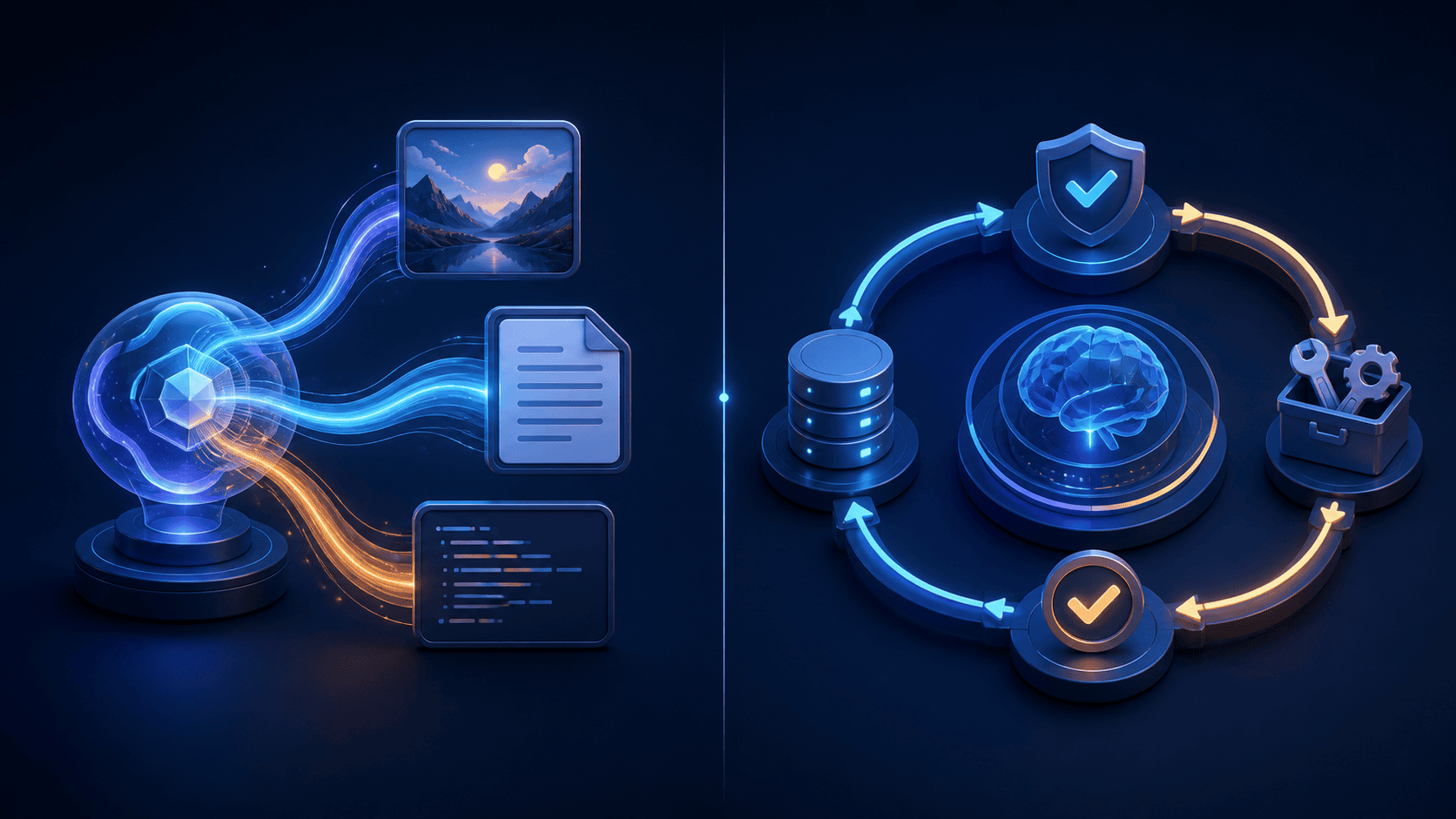
Agentic AI and generative AI are closely related, but they solve different problems. Generative AI creates or transforms content such as text, images, summaries, code, or structured drafts. Agentic AI uses a model to manage a multi-step workflow, select tools, observe results, and act within defined limits.
Most useful business systems combine the two. A generative model may draft a customer reply or summarise a document; an agentic workflow can retrieve the right information, apply policy checks, request approval, update the correct system, and record what happened.
Generative AI responds to an input by producing new content. It can help teams draft, summarise, classify, extract, translate, brainstorm, or explain. The work is usually centred on a single interaction or a short sequence where a person remains in control of the next action.
Examples include:
Agentic AI adds workflow execution. An agent receives a goal, reasons about the next step, uses approved tools to read or change systems, checks the result, and continues until it reaches a defined completion or escalation point. It should operate with explicit permissions, limits, logging, and human approval for meaningful risk.
According to OpenAI’s practical agent guide, the useful foundations are a capable model, well-defined tools, and clear instructions and guardrails. The guide also recommends starting with the simplest design that can handle the workflow rather than adding multiple agents too early.
| Aspect | Generative AI | Agentic AI |
|---|---|---|
| Primary role | Creates or transforms content | Manages and completes a multi-step workflow |
| Typical interaction | A prompt and an output for a person to use | A goal, a sequence of tool calls, and a controlled result |
| External systems | May use retrieved context | Reads from and can act through approved tools or APIs |
| Decision-making | Generates a response or draft | Selects next actions based on workflow state and tool results |
| Governance need | Review outputs for accuracy and appropriateness | Also govern permissions, actions, retries, audit trails, and escalation |
| Best fit | Content, assistance, knowledge work, and supported decisions | Complex, variable workflows that need context and action |
Consider a support team handling a delayed-order request. Generative AI can summarise the customer’s message and draft a reply. An agentic system can identify the order, retrieve delivery data, check eligibility rules, request a supervisor’s approval when needed, create a refund or replacement through an approved system, update the CRM, and prepare the final message.
The agent does not replace the generative capability; it coordinates when and how that capability is used. Good workflow design keeps sensitive actions outside the model’s unrestricted control and validates them with reliable software rules.
Use generative AI when the task is primarily to help a person think, write, retrieve, classify, or interpret. It is often the right first step when a human makes the final decision or when the workflow is simple and the output does not directly change a business system.
Examples include internal writing support, meeting summaries, knowledge-base search, proposal drafts, and research assistance. Measure whether the output saves time, improves quality, or supports better decisions.
Consider agentic AI when work involves ambiguous inputs, multiple systems, conditional decisions, and useful actions that are too difficult to encode as a fixed script. Start with one measurable workflow, such as support triage, document intake, sales research, internal service requests, or operational reporting.
It is not a reason to replace deterministic automation. If inputs are structured and rules are stable, conventional software may be faster, simpler, and easier to audit. An agent adds value when it must interpret variable information and choose a safe next action.
For a deeper technical view of agent loops, tools, MCP, multi-agent coordination, and guardrails, read our agentic AI workflow architecture guide.
Choose generative AI when you need high-quality content or assistance. Choose an agentic workflow when you need controlled, multi-step execution across systems. In most business cases, the strongest design combines both: generation where interpretation helps, and deterministic controls where accuracy, permissions, and accountability matter.
Techfusion Gear helps businesses design AI-assisted workflows, MCP integrations, and custom software around clear operational goals. Explore our custom software development services to discuss a practical implementation.