

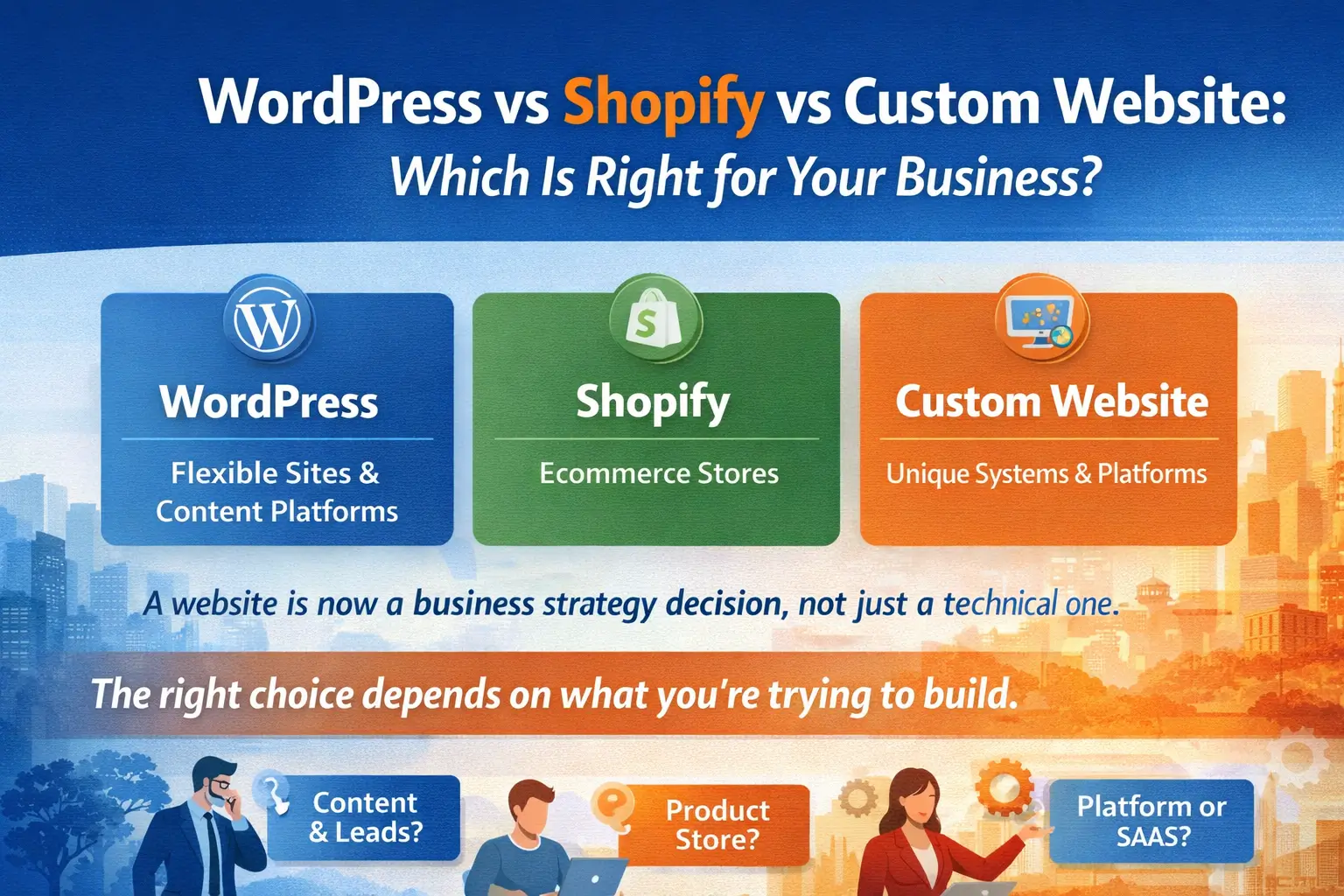
If you’re planning to build or rebuild a website, you’ll almost certainly hear the same three names: WordPress, Shopify, and custom-built websites. Each powers millions of businesses worldwide, and each is growing fast for very different reasons.
But which one actually makes sense for your business in 2026?
Let’s break it down in plain language.
Over the past few years, businesses have stopped treating websites as “online brochures”. Today, a website is expected to generate leads, sell products, build trust, and run operations. That’s exactly why the choice of platform matters more than ever.
WordPress, Shopify, and custom development are not competing in the same way. They are solving different problems.
WordPress remains the most widely used website platform in the world. Its biggest strength is flexibility.
Businesses use WordPress for:
What keeps WordPress relevant is simple: it lets businesses own their platform, control their content, and adapt their site as they grow.
Shopify has become the default choice for many brands that want to sell products online quickly.
Its success comes from:
For many merchants, Shopify removes technical headaches and lets them focus on products, marketing, and fulfilment instead of infrastructure.
Custom-built websites are becoming more common in businesses that need something more than a standard site.
These are usually:
Custom development gives full control, but it’s usually chosen when business logic drives the technology, not the other way around.
The Real Question Isn’t “Which Is Better?”
What are you actually trying to build?
What we’re seeing more and more is this:
That’s why the platform decision is no longer a technical one. It’s a business strategy decision.
WordPress, Shopify, and custom websites aren’t rivals. They’re tools for different jobs.
Choosing the right one isn’t about trends or popularity. It’s about what your business needs today and where it wants to go next.